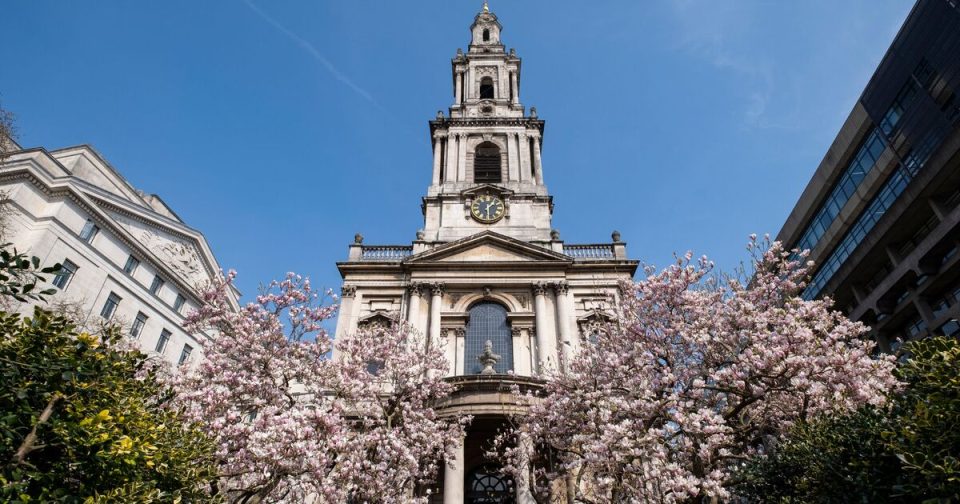

Spring blossom outside St Clements church… it was gutted in worst night of Blitz then later rebuilt (Image: In Pictures via Getty)
Winston Churchill later described it as “the most destructive attack of the whole Night Blitz”. Overnight on May 10-11, 1941, more than 500 German aircraft spent six hours raining hundreds of tons of high explosive and more than 80,000 incendiaries in the capital. Some 1,436 men, women and children perished, while 1,800 were seriously injured, and 11,000 houses were destroyed. The fires could be seen 160 miles away and 700 acres had burned – more than during the Great Fire of London.
The church of St Clement Danes on London’s Strand is the official Central Church of the Royal Air Force – the service’s “family church”. I have attended countless events there – funerals, memorials, carol services and more – before retiring to one of the local hostelries for refreshments and to reminisce with old friends.
Near the grand front entrance, across the street from the Royal Courts of Justice, is a bronze statue of a stern, uniformed and moustachioed Air Chief Marshal Sir Hugh Dowding, head of RAF Fighter Command during the Battle of Britain. Across the way stands Arthur “Bomber” Harris, mastermind of Britain’s strategic bombing campaign against Nazi Germany.
Read more: Churchill called them ‘heroes with grimy faces’ – never forget their bravery
Read more: Eighty years after VE Day, 60 WWII bombs a year are still being found in UK

Firemen fighting a blaze caused by a German air raid in September 1940 (Image: SSPL via Getty)
Even today, scars from the Blitz are easy to find. Circling the outside of the church, I can see dozens of shrapnel scars rising from the pavement to head height. The interior of St Clement Danes however is exquisite. The white ceiling and floor tiles are perfectly offset by the dark wooden pews and gallery. Hundreds of unit badges and insignia decorate the walls and floors.
High above, amid the ornate plaster moulding, is a royal crest. It’s too far for my ageing eyes to read, but a leaflet tells me that beneath the familiar lion and unicorn is a short Latin inscription which, translated, reads: “Christopher Wren built it in 1672. The thunderbolts of aerial warfare destroyed it in 1941. The Royal Air Force restored it in 1958.” The history of this place in three pithy sentences.
A newsletter describes the church’s fate that spring: “An incendiary bomb pierced the lead-covered roof, and exploded within the roof space, setting the church ablaze. “Within minutes it was an inferno, with the bell tower and Gothic steeple acting as a funnel, sending flames hundreds of feet into the air. Unable to get their hoses into the low-level river, the crews had no chance to save the beautiful building and St Clement Danes was left to burn.”
I ponder the irony of a religious site almost destroyed by one air force becoming a place of pilgrimage for another. I am mindful too of the inscription on the Firefighters Memorial a few hundred yards away, opposite St Paul’s Cathedral, bearing Winston Churchill’s famous description of those who fought the flames that destroyed our RAF church – and vast swathes of London – as “the heroes with grimy faces”.
That fateful day, May 10, 1941, the rector of St Clement Danes, William Pennington-Bickford, and his wife Louie were preparing for the next day’s services. William was determined that no matter how bad things got, his church would remain open for its parishioners. Earlier that day, Hitler had decided to attack London in reprisal for the 400-strong raid Bomber Command had launched against Berlin, Bremen and Hamburg two days earlier. Frenetic preparations were now underway, with the radio beams that would guide the German attackers activated in the late afternoon.

St Clement Danes in the Strand burns during the overnight airraids of May 10-11, 1941 (Image: Daily Mirror)
Soon afterwards, the top-secret RAF unit monitoring the system identified them intersecting over West Ham in the East End – a strong indication of their likely target. At 5.15pm phones began ringing in the offices of senior fire officers. After some debate, it was agreed that 750 appliances – a huge number by any standard – would be mobilised into the capital from outlying regions as soon as possible.
It would not be enough. An almost full moon was due to coincide with a low ebb tide on the River Thames, a combination that scared the hell out of the firefighters – excellent visibility for enemy aircraft, and an impediment to those needing water from the river. By 10.30pm – low tide – the Thames seemed almost empty, muddy banks glistening in the moonlight. Fifteen minutes later, the 20 bombers of the Luftwaffe Fire Raisers crossed the coast in Dorset.
Radar stations began picking up further indications from across France, Belgium and the Netherlands of hundreds of enemy aircraft taking to the skies. As the phones trilled in Fighter Command, WAAF plotters began their anxious work. At 11pm, as their map tables started to fill with red arrows, the target became obvious. London. At 11.02pm the German pathfinders arrived, as predicted, over West Ham, and began dropping their incendiaries.
A butcher’s shop was among the first buildings to be hit. A group of drinkers in the pub across the road dashed tipsily over to see if they could help. A spirited pair hammered away at their stirrup pump for a full minute before one shouted: “You bloody fool! There’s no water in the bucket!”
With the dreadful drone of bombers rising to a crescendo overhead, the docks and East End were soon aglow with the blue-white light of magnesium firebombs sizzling and sparking on roofs, roads and pavements. Ballard Berkeley, the matinee idol who later played the Major in Fawlty Towers, was a Special Constable on duty near Leicester Square. “It was a beautiful night and the city was getting well lit up,” he recalled.
“We heard the screech and down came the incendiaries… It was the night of the Cup Final and as the bombs came down, the newspaper seller just stood there shouting, ‘Star, News, Standard, Cup Final Result!’

Inside St Clement Danes on May 14 1941 (Image: Daily Mirror)
“A prostitute came up from Piccadilly and as the incendiary bombs came down, she put her umbrella up and started singing ‘I’m Singing in the Rain’, I remember thinking at the time, ‘I wish Hitler and Goering could have a look at this’.” As the raid gathered momentum, a porter at St Pancras railway station watched as a flare fell from the sky, followed by the whistle of high-explosive bombs. He dived for cover as thousands of panes of glass in the station roof shattered.
Shortly after midnight, there were already six conflagrations logged in the central fire control room. Several pumps dashed to Buckingham Palace following a call – the royal family were away at Windsor Castle – but found the gates locked.
A group of intrepid firefighters scaled the ironwork before breaking into the building itself. To their relief, they found scorch marks at the top of the building but no actual blaze. Sub-Officer Cyril Demarne, helping to lead the fight in east London, described how “demand soon overran supply as fresh fires were started – the flow became further depleted with the inevitable fracturing of trunk mains.”
Fireboats lay 50 yards from the banks of the Thames, running their hose lines ashore over mud flats from “what looked like a village stream, so low was the tide”. There were far too many thirsty pumps for the boats to be able to help, and frantic crews were directed to public swimming pools, canals and ponds. Some set their pumps into flooded bomb craters and even underground sewers. One crew watched in horror as the crater they were draining slowly revealed an unexploded 250kg bomb, fin pointing to the sky.
Fireboats chugging up and down the Thames may have been at arm’s length from danger, but not from the horror. One crewman caught sight of a body floating under Blackfriars Bridge, “scorched brown and horrible. What got me most was that this thing had no head. I’d seen bodies before – shrivelled and shrunk and burnt like this – but they’d always had a head”.
Yet fate could be fickle. At one point, a high-explosive bomb landed in Great Titchfield Street in the West End, yards from a passing ARP warden. Experiencing “a monstrous hairbrush” skimming the top of his head, he was thrown through the air before being deposited so softly 30 yards away that it felt like “climbing into bed”.

Inside the main body of St Clement Danes in wake of devastating air attack on London (Image: Getty)

Inside the restored St Clement Danes, the RAF’s ‘family church’, today (Image: Getty)
To the south of the river, things were also turning very sour. One senior fire officer was on his way through Elephant and Castle, when his driver hit the brakes. Flames began to rain from the skies in the form of multi- coloured parachute flares and incendiaries. By 12.15am, local teams were dealing with a five-acre blaze. Here, too, water was a serious worry. The first pumps on the scene emptied a 5,000-gallon tank in five minutes. Every water main was dry, and a series of explosions hindered their efforts, bursting and burning hoses.
The physical demands on firefighters were almost unendurable – lungs full of smoke, heat so severe it caused lampposts to wilt as the fire tore mercilessly through the city.
After hours of near-misses, the church of St Clement Danes was hit by incendiaries and, before long, its tower was alight. Flames were soon writhing from every window and door. The last bomb fell on the north-west turret of Scotland Yard at 5.37am. The raid was at an end. Overnight, St Clement Danes had become a burned-out shell.
The scale of the destruction across London was staggering. The transport system was in chaos, roads were blocked, communications severed, gas supplies interrupted.
It would take until the following day for the inferno at Elephant and Castle in south London to be brought under control. As the fires diminished, the grieving began. The wife of a fireman began to fear the worst when he didn’t return for breakfast.
One of his colleagues raced to break the awful news but was beaten to it by a policeman telling her: “You’re wanted to identify a body at Hackney Mortuary.” She arrived to find many others doing the same, hearing one man ask another: “How many are you here for, mate?” The answer was four – his wife, sister and two daughters.

Blitz: When World War Two Came Home, by John Nichol is out now (Image: Simon & Schuster)
A month or so after the attack, St Clement Danes’ rector William died aged 67, reportedly “of a broken heart”. One of his devoted congregation noted, “since the first damage, we have seen him dying before our eyes”. Louie, his wife of 36 years, suffered “utter desolation” and, for weeks after William’s death, prayed nightly that “she might be taken too”. One evening, at her temporary home in Sussex, she climbed the stairs and threw herself from the attic window.
The RAF Church they served would be rebuilt into the grand building it is today.
After the war, historians would later describe the period from September 7, 1940, to May 11, 1941 as the “Night Blitz”.
But as I describe in my book, the bombing was far from over and there would be more attacks across the nation – including the
so-called V-1 and then V-2 “revenge weapons” – until a few weeks before VE Day. More than 60,000 civilians would die, 90,000 seriously injured – and 300 firefighters died in London alone – Churchill’s “heroes with grimy faces” who sacrificed everything for their nation and neighbours.
- Edited extract by Matt Nixson from Blitz: When World War II Came Home, by John Nichol, published by Simon & Schuster priced £25 and out now
